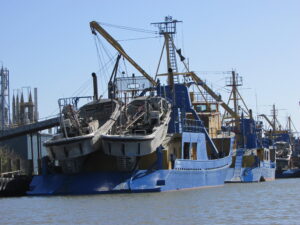
Our Comment on Louisiana’s Menhaden Buffer Zone Proposal
By Johnny Marquez and Connor Gilbert
Dear LWF Commissioners and LDWF Secretary Bosworth:
Vanishing Paradise respectfully submits the following comments on the proposed Notice of Intent (NOI) to amend LAC 76: VII.307 regarding the existing half‑mile commercial menhaden buffer zone. Vanishing Paradise is a program of the National Wildlife Federation that unites sportsmen to advocate for conservation and restoration of wildlife and habitat in the Mississippi River Delta, throughout the Gulf Coast and in the Everglades with a primary focus in Louisiana.
Concerns about the impact of the commercial menhaden fishery on Louisiana’s overall fisheries and marine habitat have existed for years. While the fishery has not been deemed to be overfished or experiencing overfishing with respect to the stock status, menhaden are a forage fish that serve as a filter feeder and a critical food source for a variety of game fish, marine mammals, sea turtles and birds throughout Louisiana and the Gulf and play a crucial role in the management of the ecosystem that should be considered beyond the management of the menhaden stock. In addition to the removal of menhaden from the biomass through the commercial fishery, a recent bycatch study undertaken by LGL Associates and funded by the LDWF showed that the commercial fishery resulted in the removal of nearly 146 million additional fish annually as unintended bycatch. The removal of menhaden as a key food source, bycatch concerns in the fishery and damage to Louisiana’s fragile marsh habitat and ecosystem have all been of great concern to sportsmen as Louisiana continues to lose land and its vital estuaries at an alarming rate. Moreover, we continue to see declines in key game fish species
like speckled trout, redfish and tarpon that have resulted in more restrictive harvest regulations for recreational anglers in major fisheries.
Following numerous fish spills by the industry, ongoing user conflicts regarding operations in near shore areas, concerns regarding bycatch and damage to our estuaries, the Louisiana Wildlife and Fisheries Commission (Commission) considered and approved a NOI that proposed a statewide buffer of one-mile from shore, special management zones with a three‑mile buffer around Holly Beach and Rutherford Beach, and new reporting and clean‑up requirements related to intentional or unintentional spills. Vanishing Paradise supported the one-mile buffer as proposed. However, the Commission amended the original NOI to establish a half‑mile coastwide buffer, a one‑mile buffer around Holly Beach and Rutherford Beach, and a three‑mile buffer around Grand Isle after the industry claimed that it would suffer reduced harvest and economic hardship as a result of the one-mile buffer. Subsequently, the new rule with a halfmile buffer went into effect, and the industry operated under that buffer with seemingly little impact to its harvest numbers or profitability. Now, less than eighteen months later, the industry seeks to reverse that agreement, and the Commission has issued a NOI that is not based in science or any other need to reduce the buffer. We oppose the reduced buffer zone, other than the zones created around the Chandeleur Islands for the following reasons.
The Commission should utilize science-based decision-making in any rule change.
Vanishing Paradise supports science-based decision-making for Louisiana’s fisheries and coastal habitats. We commend the commission for funding the $1 million bycatch study conducted by LGL Ecological Research Associates. The study provided helpful data on the sheer volume of bycatch, nearly 146 million fish, that are removed each year by the commercial menhaden fishery in addition to the menhaden. Because there is no limit on the harvest of menhaden in Louisiana or the Gulf, the bycatch numbers are massive. While the study was helpful and showed that there was a higher incidence of bycatch in waters shallower than 22 feet, it did not drill down and analyze the data for bycatch to determine if levels were higher in shallower waters closer to shore. Moreover, because the study was conducted while the half-mile buffer was in place, it specifically did not examine whether the impacts on bycatch would be more severe in the near shore waters between one quarter and one half mile that will be opened to the commercial fishery under the proposed NOI. It would stand to reason that nearshore waters that are a mere 1300 yards from shore are likely to have greater concentrations of game fish like speckled trout, red fish, tarpon and other species that could end up as bycatch; however, further analysis and study is needed to determine the impacts on bycatch in these near shore waters. The Commission should examine the impacts to bycatch within the reduced buffer zone and adjacent areas before making a decision to reduce the buffer without any science-based information to support that decision.
There is no economic necessity for the reduction in the buffer to one quarter mile.
While the menhaden industry opined that it would suffer severe financial hardship, a reduction in harvest and revenue, and a corresponding loss of jobs in Louisiana if a buffer was instituted, there is no evidence that the industry suffered any hardship by implementing the half-mile buffer. In fact, the NOI was proposed before the harvest numbers for this year were even available to be examined. Harvest levels have remained consistent with historical levels and may have even increased, and it appears that the dockside value of the product has increased substantially, resulting in a more profitable year rather than a less profitable year. Furthermore, no evidence has been presented that would indicate that the industry has suffered job losses or other financial hardships as a result of the half-mile buffer. There is no reason for the Commission to move forward with a reduced buffer at this time given the economic health of the industry.
The Commission should consider implementing a Total Allowable Catch (TAC) in any new menhaden regulations.
We also encourage LDWF and the Commission to consider the impacts of menhaden harvest on the eco-system as a whole and the impact on other fisheries that depend on menhaden. At present, there is no limit on the volume of menhaden that can be removed in Louisiana other than the time frame for the season and location of the harvest. Louisiana is currently responsible for 70 percent of the removals in the Gulf and as pressure mounts on the menhaden fishery on the east coast, there is nothing to prevent increased effort and harvest in Louisiana. Accordingly, the Commission should consider implementing reasonable limits on the amount of harvest that will support both the stock and the other fisheries that depend on menhaden.
Establishing a science-based TAC that considers the needs of the fishery as well as the ecosystem would provide improved accountability and protection to avoid even more pressure on the fishery. A TAC would allow for consistent management of the fishery that considers all the
needs of Louisiana’s ecosystem and fisheries.
Protections for the Chandeleur Islands and Breton National Wildlife Refuge (NWR)
We strongly support the proposed protections to create a buffer for the Chandeleur Islands and request that the area be correctly identified as the Breton National Wildlife Refuge (NWR) as it encompasses the Chandeleur Islands as well as the Breton, Curlew and Grand Gosier Islands. The Breton NWR is the second-oldest national wildlife refuge in the U.S. and supports and provides vital habitat for fish, endangered sea turtles, birds and sea grass. These islands create the conditions needed to support the only marine seagrass beds in Louisiana, including manatee grass, shoal grass, turtle grass, and widgeon grass. These grass beds are part of what make these islands one of the best recreational fishing areas in the northern Gulf and should be protected. In addition, these islands have recently been found to be important nesting habitat for endangered
Kemp’s ridley and threatened loggerhead sea turtles.
Louisiana is currently working on large scale restoration project for the Chandeleur Islands that will cost anywhere from $250-$300 million. The restoration is designed to protect the islands as well as the sea grass beds. The investments in these unique barrier islands and habitat should be protected by a strong buffer zone.
As part of the Breton NWR, the islands are already protected by an approximately 800-foot protection zone. We support enhancing that zone to a two-mile buffer zone to ensure adequate protection for the islands, surrounding grass beds and wildlife that use those critical habitats. We request that the Commission ensure that it is not characterizing the existing 800-foot buffer zone mandated for the NWR as part of any “new” protections being created through the NOI to offset the proposed reduction in the buffer zone throughout the rest of Louisiana.
Thank you for your consideration of these comments. We look forward to continuing to work with LDWF and the Commission to protect Louisiana’s coast and fisheries through transparent, science-based management and decision making.
Sincerely,
Johnny Marquez
Sr. Manager, Sportsmen’s Advocacy
Vanishing Paradise
National Wildlife Federation
Connor Gilbert
Sportsmen Outreach and Policy Specialist
Vanishing Paradise
National Wildlife Federation